
Freedom is your Park
Client: Freedom Park Conservancy
As part of a two-person design and marketing team at HBK Creative, I helped develop and pitch a brand campaign and create graphics, brand assets, signage, and merchandise for Freedom Park, a historic and iconic park spanning multiple neighborhoods in the heart of Atlanta. We met with members of the Freedom Park Conservancy board throughout the process to respond to budgeting and feedback.
Branding, Environmental, Print
June - August 2025
Role: Design and Marketing
Goals
-
Build visibility within the park using branded signage.
-
Present the unique features of the park and encourage attendance.
-
Use thoughtful donor incentives to encourage support for the park and spread the word throughout Atlanta neighborhoods.
Jump to…
Park History
Freedom Park bordering Freedom Parkway, a road heading towards Downtown Atlanta
A park within the city
Freedom Park is one of the largest parks in Atlanta, with its unconventional but linear layout spanning 200+ acres. The park weaves between multiple neighborhoods on Atlanta’s East side, offering transport between them via of Atlanta’s Beltline trail, a dedicated paved walking/biking path. Freedom Park’s unique feature of connecting so many parts of Atlanta is also a cause of its struggle with visibility. With sections ranging from large green spaces to narrow trails, you can be traversing through Freedom Park without even realizing it.
A plaque located in Freedom Park detailing CAUTION’s efforts
History, highways, and community
The unconventional layout of Freedom Park wasn’t entirely planned. In fact, the park wasn’t planned to be a park at all initially, with plans originally envisioning an expressway. The park was in fact born from decades of local activism, most notably from the neighborhood group CAUTION (Citizens Against Unnecessary Thoroughfares in Older Neighborhoods). The effort was ultimately supported by civil rights leader John Lewis, who was a City Council Member at the time. Ultimately, Freedom Park was formed, and the more scaled-back roadway of Freedom Parkway would run through it.
A map of Freedom Park’s layout in Atlanta
At the center of the park is Jimmy Carter’s presidential center, but he isn’t the only Nobel Peace Prize winner connected to the park. The park connects to the Martin Luther King, Jr. National Historic Park and the King Center. Thus, not only is Freedom Park rooted in local activism, but its the only park in the world to connect the centers of two Nobel Peace Prize winners.
One of the few instances of major signage in Freedom Park before this project
Struggling with visibility
The Freedom Park Conservancy, HBK Creative’s client for this project, emphasized to us the lack of existing signage in the park. The sign above, located in the Inman Park neighborhood, was one of the few major instances of Freedom Park being clearly marked, and it rests outside of one of the large green space areas of the park.
Despite its captivating legacy, its feature of connecting multiple neighborhoods, and the beautiful public art lining parts of its paths, Freedom Park is underappreciated because park-goers are simply often unaware that they’re even in Freedom Park. The park’s unique layout, the Freedom Park Conservancy believes, is part of its strength and charm. However, it also poses a great challenge. If the Atlanta community is to appreciate, enjoy, nurture, and further invest in Freedom Park, they need to know where it is and what it has to offer.
This challenge is what the two-person team of myself and the lead designer at HBK Creative set out to help solve with the resources available to the Freedom Park Conservancy.
Brand Campaign
Existing branding
The park’s logo, used as the primary icon for both the park itself and the Freedom Park Conservancy, takes its form from the layout of Freedom Park. While we were free to come up with an entirely new tagline for this campaign, we instead pitched the idea of building upon the existing tagline, an idea that the Conservancy enthusiastically approved of.
Freedom Park’s unique features
In addition to diving into research on the history and legacy of Freedom Park, we wanted to catalogue the park’s features. The aforementioned Beltline trail makes the park a top choice for running, walking, and biking in Atlanta’s eastern neighborhoods. Parts of the trail are adorned with large installation art, both permanent and temporary.
Expanding the tagline
Referencing our research on Freedom Park’s unique features, we began exploring variations of an expanded tagline. We wanted each tagline to be a succinct as possible, while clearly communicating what aspect of the park it represented.
Some of our initial taglines, like “Freedom is your Art Park” were immediately effective. Others proved difficult, such as “Local” and “Hub”. We found that the broader the concept, the harder it was to communicate with just a word or two.
Adding imagery
Working with the large color palette of the Freedom Park branding, we recognized the opportunity to designate a brand color for each of our tagline variations. We also kept in mind the goal of building awareness for the park and its brand, and felt strongly that featuring bold colors and a recognizable style would help.
Though we considered simple graphics or icons, we wanted to still work with a lot of the detail of photographs, even if we were committed to flat, bold graphics. We landed on a posterized style for each image, and experimented with what could best pair with our taglines, which were still in-progress.
Finalizing the taglines
After numerous drafts if both the taglines and the graphics, and presenting our concept to the Freedom Park Conservancy, we used their feedback to narrow down to four pillars of Freedom Park.
“Freedom is your Art Park” nods to the park’s dedication as Atlanta’s public art park. It represents the ever-changing variety of public installation art that can be found in the park, with its paired graphic featuring an iconic part of the permanent collection, Tree of Life by Yvonne Domenge.
“Freedom is your Intown Greenway Park” combines multiple features of the park under one tagline. The park’s utility for walking, running, and biking, its no-car trails connecting multiple neighborhoods, and it’s abundant greenery are all represented.
“Freedom is your Nobel Peace Park” highlights the park’s connecting of two Nobel Peace Prize winner’s centers, The King Center and The Carter Center.
“Freedom is our Legacy Park” honors the park’s history rooted in activism and community action, with civil rights leader John Lewis featured alongside the tagline. For this tagline alone, we changed the wording to “our” to clearly communicate that Freedom Park remains part of the Atlanta community’s legacy.
Building graphics
With the taglines and images set, we began brainstorming on how the lightpost banners would actually look. Freedom Park’s master plan document, a comprehensive research and proposed plan for investing in the park, had been a guiding resource in our understanding of the park. It had also been visible on the Freedom Park Conservancy’s website for some time, so we knew that there was at least some level of recognizability to Freedom Park’s branding, which was heavily used in the document.
We were inspired by chapter covers from the document and found that their bold emphasis on a single color matched our vision for the four taglines we had created. Though we initially looked to use solid backgrounds for each tagline on the lightpost banners, we tried replicating the ripple effect found in the chapter headers.
With plenty of fine-tuning, we were pleasantly surprised by how well the ripple effect worked with our graphics.
I developed and recorded a process to ensure that there was consistency across all the ripple effects. I also built out expansive working files of each one, so that anyone could easily resize them for future formats. The graphics for Martin Luther King Jr. and Jimmy Carter posed a challenge, as they needed to be able to intersect cleanly even if moved around. For them, I worked to develop an approachable and endlessly editable process of combining them that future designers for Freedom Park could follow.
Just as in the chapter covers from the master plan, we added a semi-transparent highlight between the tagline text and the ripple background to ensure they had enough contrast to be easily readable.
Deliverables
Lightpost banners
We formatted the graphics we had designed for vertical 2’x4’ lightpost banners to be put up along Freedom Park. We also designed an additional banner to guide potential new donors to the Freedom Park Conservancy website.
A mockup of the full banner lineup
Once the banners were produced (see Results & Impact section), they would be mounted to existing lightposts in along the Beltline trail in Freedom Park. The design would alternate, ensuring that between each set of the four taglines would be a fifth banner featuring a scanable QR code for donors.
Donor rewards
The remaining deliverables for this project were set to be items that could be given to donors as both a thank you for supporting Freedom Park, and a way for them to take the brand campaign with them to raise awareness of the park.
Many staples of merchandise came to mind for these donor rewards. In our conversations with the Freedom Park Conservancy, making rewards that donors would actually be proud to display was a priority.
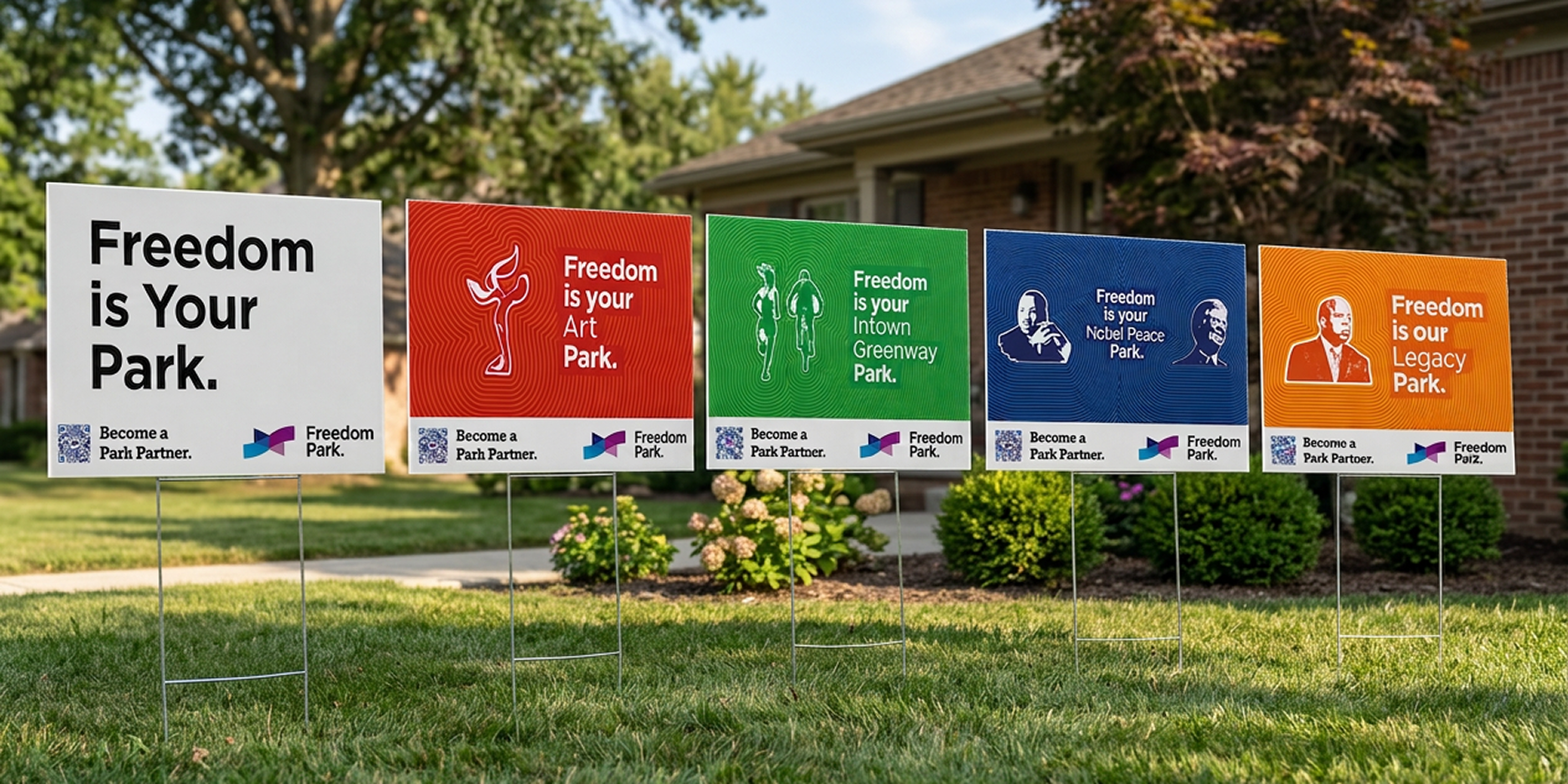
Yard Signs
One of the donor rewards we settled on was yard signs. In the neighborhoods connected to Freedom Park, who are almost certainly home to many of the people most likely to donate to the conservation, you can easily find front yards adorned with signs supporting local organizations or political causes. Many of those yards face busy small streets with lots of foot traffic. We recognized the opportunity for donors to extend the reach of the Freedom is your Park campaign into greater Atlanta by proudly planting the graphics in their yards.
A mockup of the full yard sign lineup
Importantly, the yard signs featured just as much variety as the lightpost banners. Donors have the opportunity to choose a favorite tagline to display in their yard.
Each sign features a QR code to guide any interested passerby to donate as well.
Tote bags
The second donor reward option that we landed on were tote bags. While promotional branded apparel is often not worn outside the house, we felt that tote bags, due to their utility, could be a more appreciated reward.
Working with the scale of tote bags and their tendency to, of course, not remain perfectly flat in use, we quickly realized a more minimal approach was necessary for their graphics. Rather than use the imagery or ripples, we soon decided to prioritize the taglines themselves, while still including a small logo.
We experimented with several variations of scale and composition pairing the taglines with logos to ensure that we find one that works for the varying lengths of taglines.
Once we settled for a layout for the taglines, we experimented with having colorful bags vs colorful graphics. Ultimately, the natural look of a traditional beige canvas tote felt at home in the abundant greenery of the park.
A mockup of the full tote bag lineup
Once again, we felt it was important to provide donors with a choice of their favorite tagline. By letting donors choose their favorite design for both the yard signs and tote bags, they may feel more appreciated and excited to rep Freedom Park.
Final deliverables
Together, the lightpost banners, yard signs, tote bags, and the graphics themselves are unified in a bold, exciting new identity for Freedom Park. Each deliverable works towards the goal of emphasizing a compelling reason to visit and enjoy the park.
Results & Impact
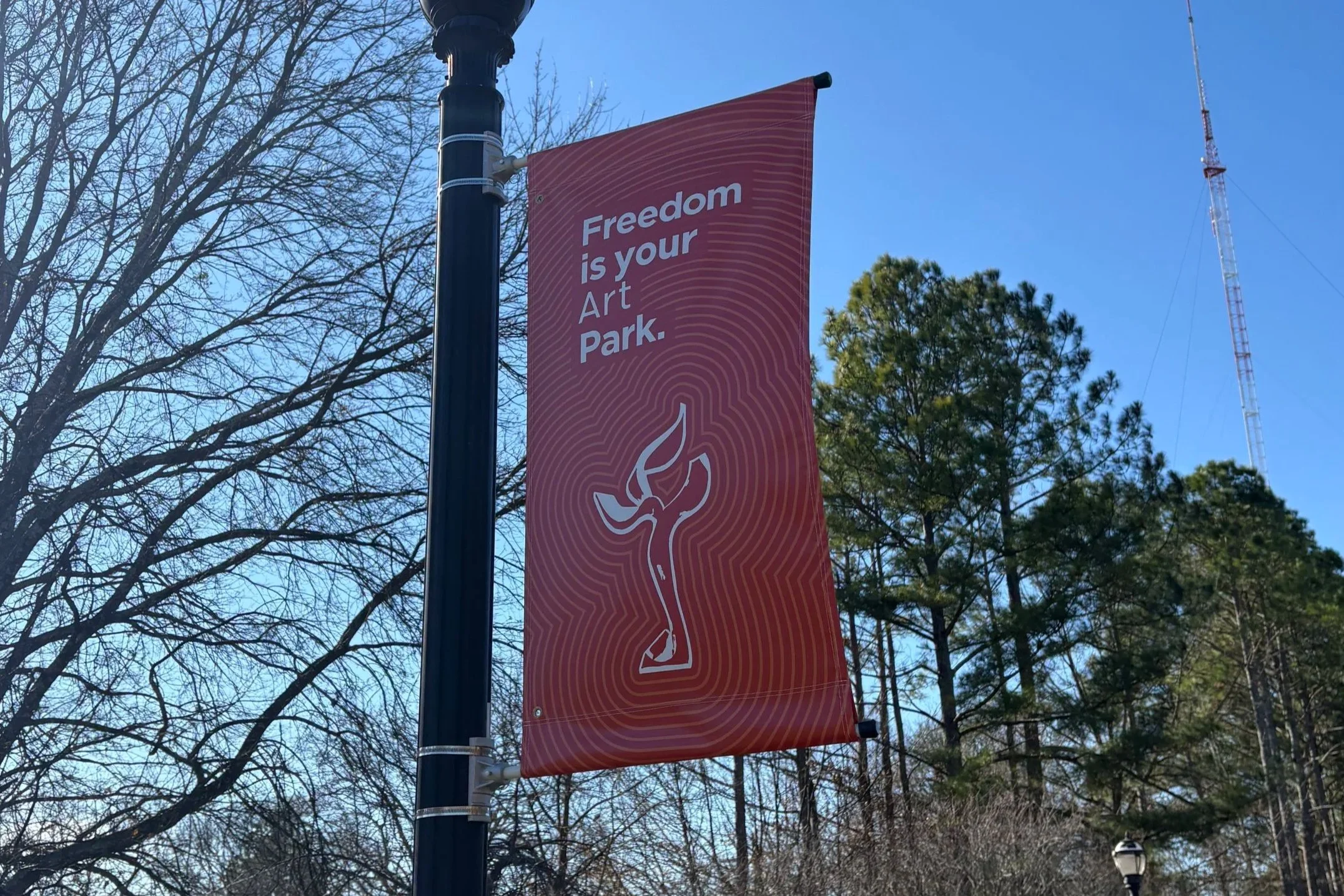
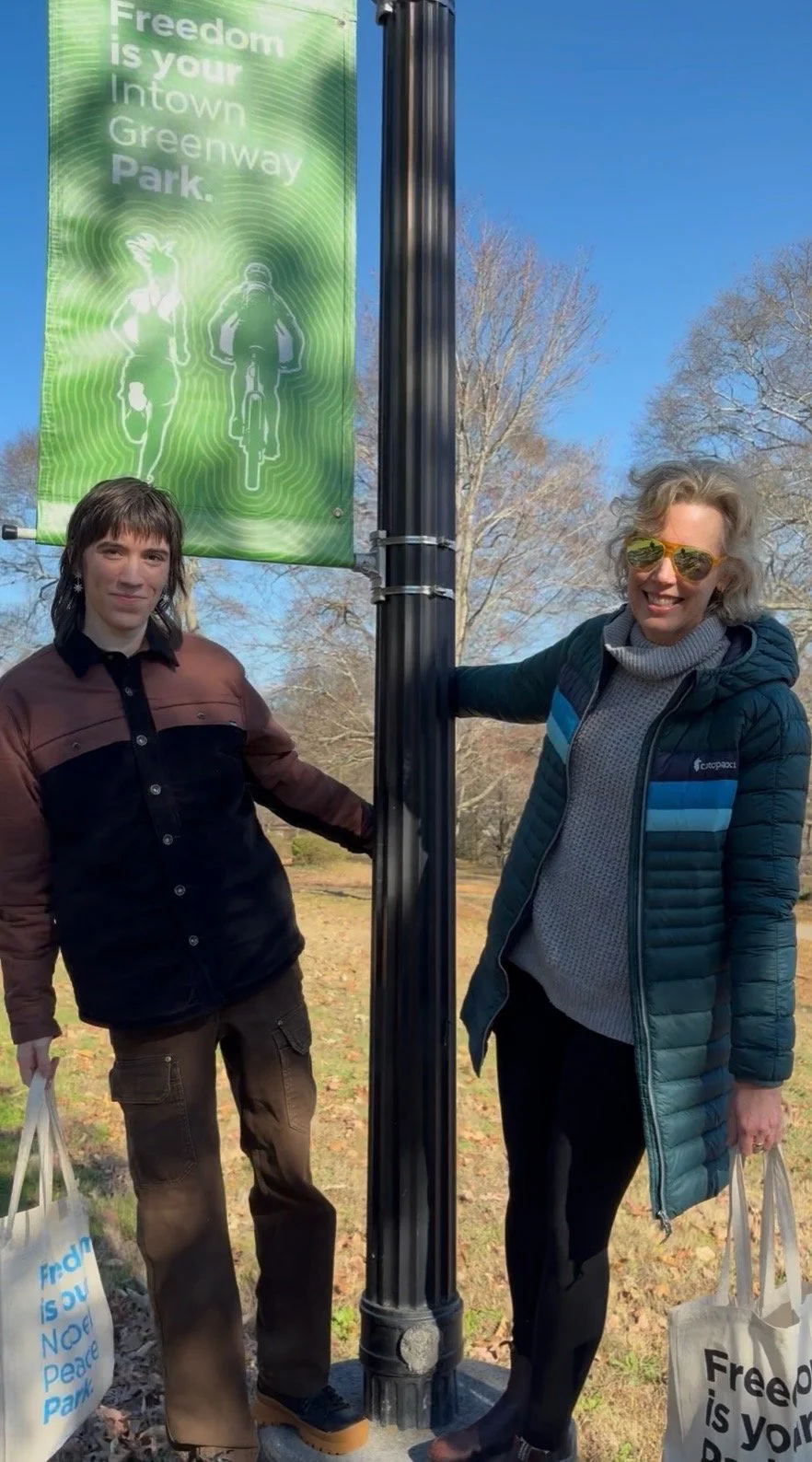
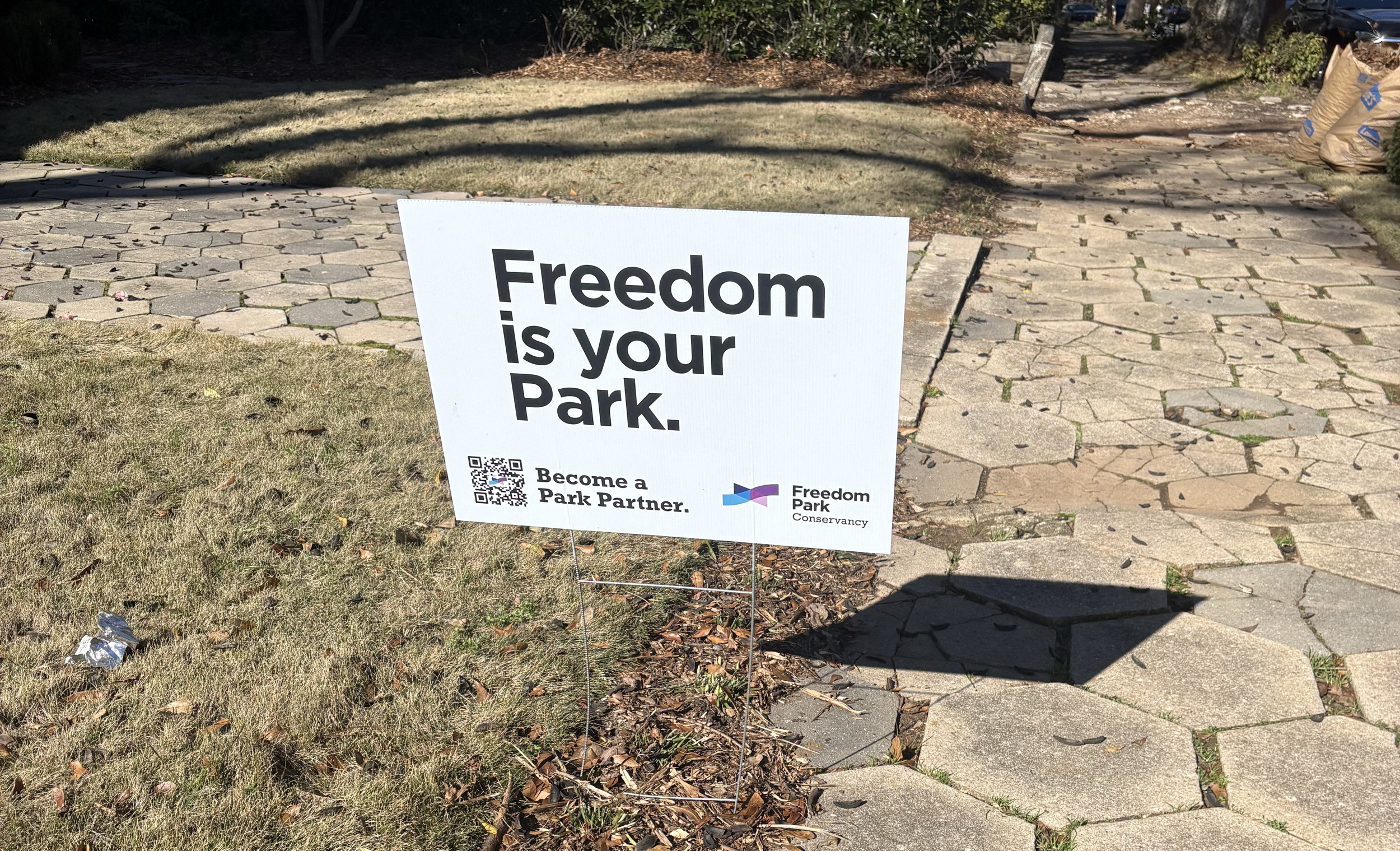
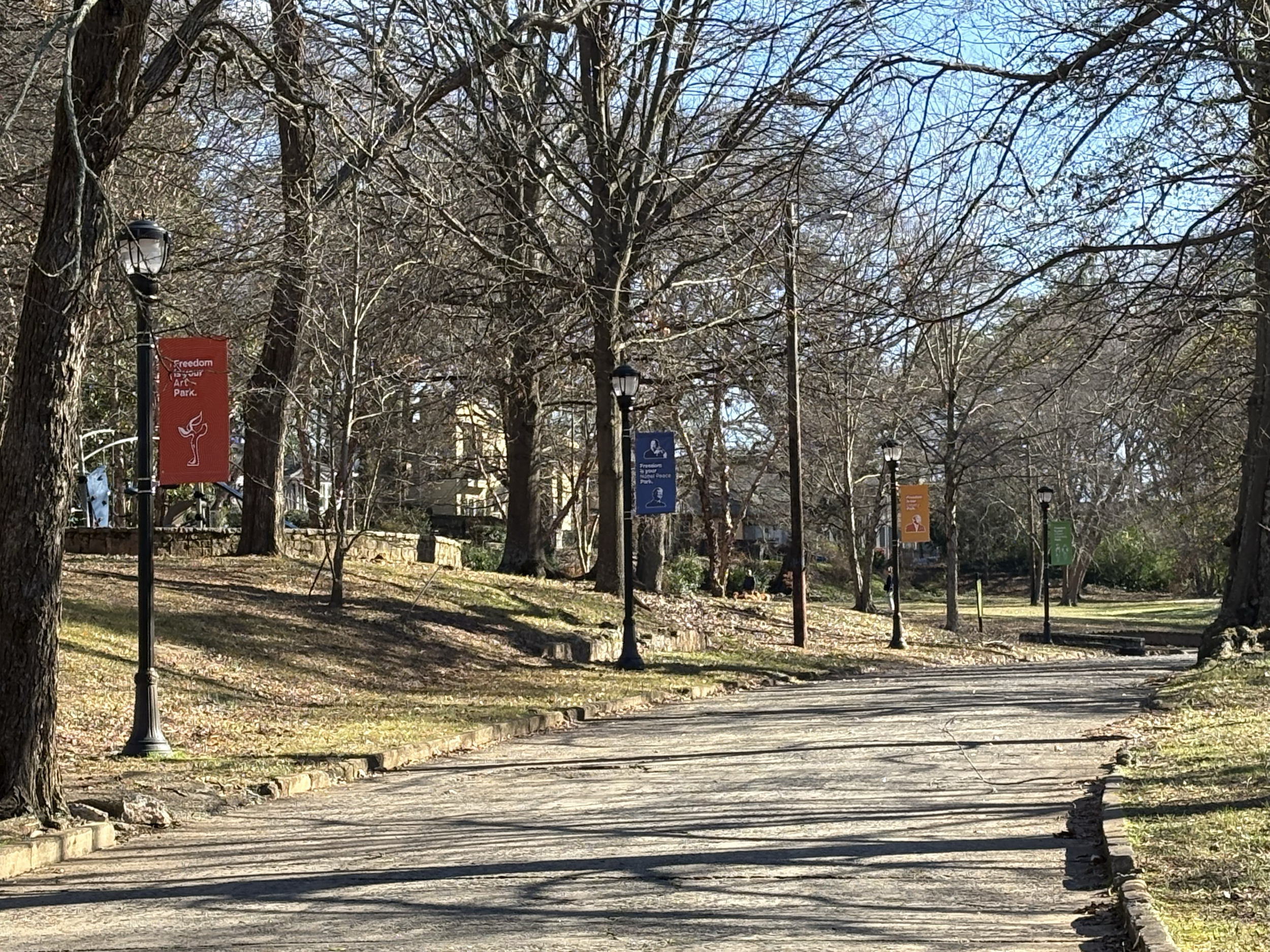
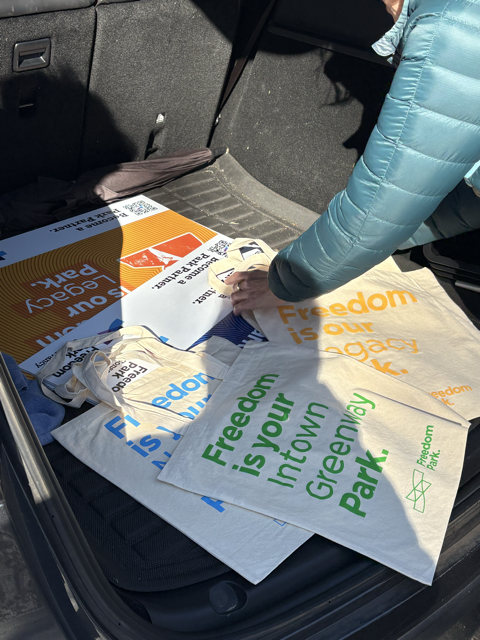
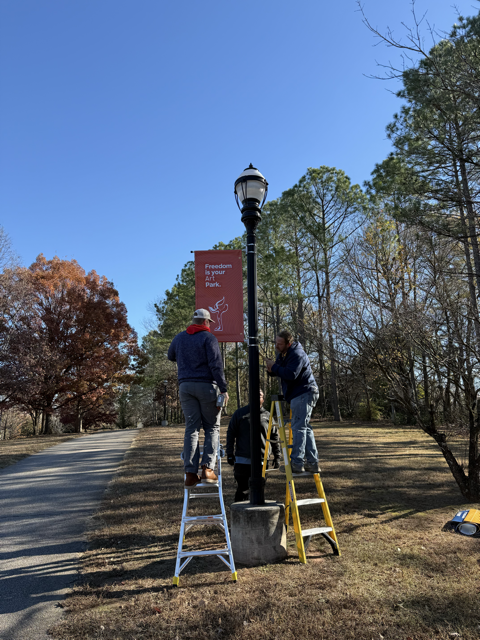
By early 2026, the lightpost banners were installed along the park, boosting its visibility well ahead of time for the FIFA World Cup.
Donor gifts also became available, and many yard signs could be observed in surrounding neighborhoods in Atlanta.
Freedom Park continues to raise funds and increase its visibility both in Atlanta and nationwide. The brand campaign we created continues to be used on the Freedom Park Conservancy website and social media pages.